
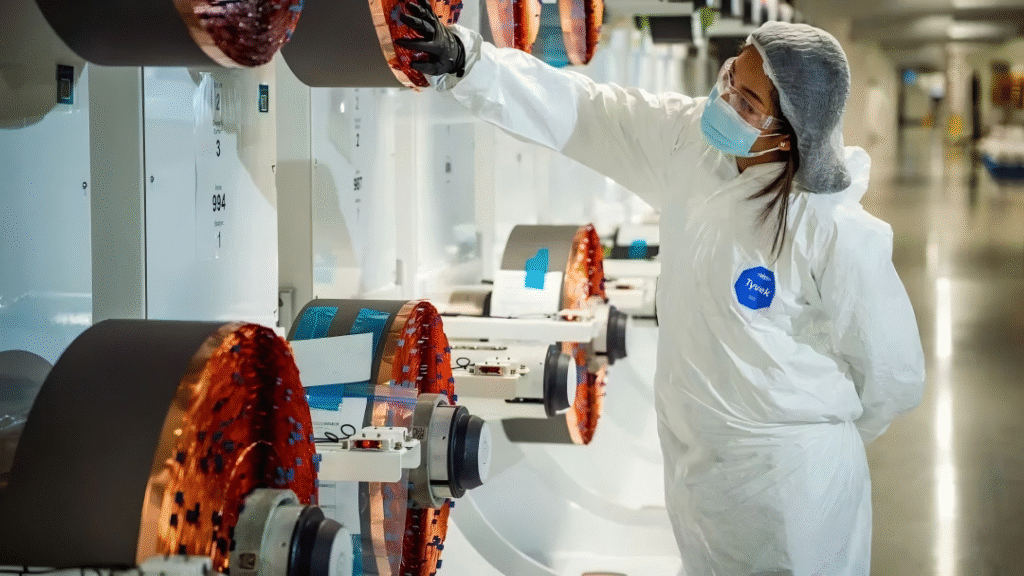
Just six years after its establishment, Norwegian battery manufacturer Morrow Batteries has entered bankruptcy proceedings.
For many in the industry, this is more than another startup failure.
It raises a bigger question:
Can Europe build a competitive battery manufacturing ecosystem fast enough to keep pace with Asia’s scale, cost structure, and industrial maturity?
Morrow’s story may become one of the clearest case studies yet.
From Ambition to Bankruptcy in Six Years
Morrow Batteries was founded with a clear vision:
Build a sustainable European battery supply chain.
The company focused on:
🔋 LFP (Lithium Iron Phosphate) batteries for ESS and EV applications
⚡ LNMO-X (High-voltage Lithium Nickel Manganese Oxide) chemistry for next-generation batteries
Backed by industrial investors including Siemens, Morrow positioned itself as part of Europe’s battery independence strategy.
Its ambitions extended beyond cell production:
- Localized European supply chains
- Sustainable manufacturing
- Strategic industrial partnerships
And notably:
Just months ago, the company announced several milestones:
✅ First defense industry cooperation agreements
✅ Long-term supply framework with Finland’s Proventia Oy
✅ Successful mass production and delivery of high-performance LFP cells at its Arendal plant in southern Norway
On paper, progress seemed real.
Yet the company still collapsed.
The Problem Was Not Technology
Morrow stated clearly:
The bankruptcy was not caused by weak products or lack of competitiveness.
Instead:
Cash ran out.
The company explained:
“Technology progress alone could not fill the cash flow gap.”
This statement may summarize the challenge facing many battery startups globally.
Battery manufacturing is brutally capital-intensive.
Success requires simultaneous victories in:
- Technology
- Yield
- Scaling
- Customers
- Supply chain
- Financing
Failing any one of them can become fatal.
Heavy Industry Needs Heavy Capital
Battery production is not software.
It is not even conventional manufacturing.
Battery gigafactories require enormous investments:
- Production equipment
- Dry rooms
- Material systems
- Yield optimization
- Qualification cycles
- Safety systems
- Workforce development
Revenue often arrives years after investment begins.
Meanwhile:
Cash burns continuously.
Morrow’s board acknowledged:
Global market conditions and investment requirements made growth far harder than expected.
Europe’s Battery Industry Faces Structural Pressure
Morrow had already warned earlier this year:
Europe faces:
⚠ Overcapacity concerns
⚠ Import-driven price pressure
⚠ Rising production costs
This combination is extremely difficult.
Because Europe competes simultaneously against:
- Asian manufacturing scale
- Lower-cost imports
- Local energy costs
- Higher labor expenses
The economics become challenging.
Morrow Is Not Alone
Morrow’s bankruptcy is not an isolated case.
Recent setbacks across Europe include:
Northvolt
One of Europe’s flagship battery projects now facing severe financial pressure.
ACC Gigafactory
The joint venture involving:
- Mercedes-Benz
- Stellantis
- TotalEnergies
Its Kaiserslautern superfactory plans were suspended.
Farasis Energy Europe
Its expansion plans in Bitterfeld also failed to materialize.
The Bigger Question: Can Europe Build Competitive Battery Capacity?
Even research institutions have become cautious.
Previous assessments suggested:
Only 54%–75% of announced European battery capacity may actually be realized.
Projected operational capacity by 2030:
≈1.2–1.7 TWh
Still significant.
But below many earlier expectations.
Why Asian Battery Makers Continue Leading
The challenge is not only technology.
Asia built advantages over decades:
Manufacturing scale
China alone built massive ecosystems around:
- Materials
- Equipment
- Processing
- Engineering talent
Supply chain integration
Cathodes → anodes → electrolytes → separators → packs
Many suppliers operate within regional clusters.
Manufacturing learning curves
Battery production success depends heavily on:
Yield.
Not lab data.
Not prototype performance.
Yield.
And yield comes from years of process experience.
The Hidden Lesson: Battery Competition Is Becoming Industrial Competition
Morrow reminds us:
Battery competition is no longer purely about chemistry.
It has become competition between:
Industrial ecosystems.
Winning requires:
Technology + Capital + Supply Chain + Manufacturing + Market Timing
Missing one element may break the model.
What Does This Mean for the Future?
Europe’s battery ambitions are not ending.
But expectations may become more realistic.
The likely direction may shift toward:
- Strategic partnerships
- Selective localization
- Higher-value applications
- Stronger cooperation with global players
Rather than attempting full industrial independence immediately.
Final Thoughts
Morrow achieved:
✔ Product development
✔ Pilot production
✔ Strategic partnerships
✔ Market validation
Yet it still failed.
Why?
Because battery industrialization is not won in laboratories.
It is won in factories.
And factories need capital, scale, and time.
For the global battery industry, Morrow’s story is not simply a bankruptcy case.
It is a reminder:
In batteries, technology gets attention. Manufacturing determines survival.