
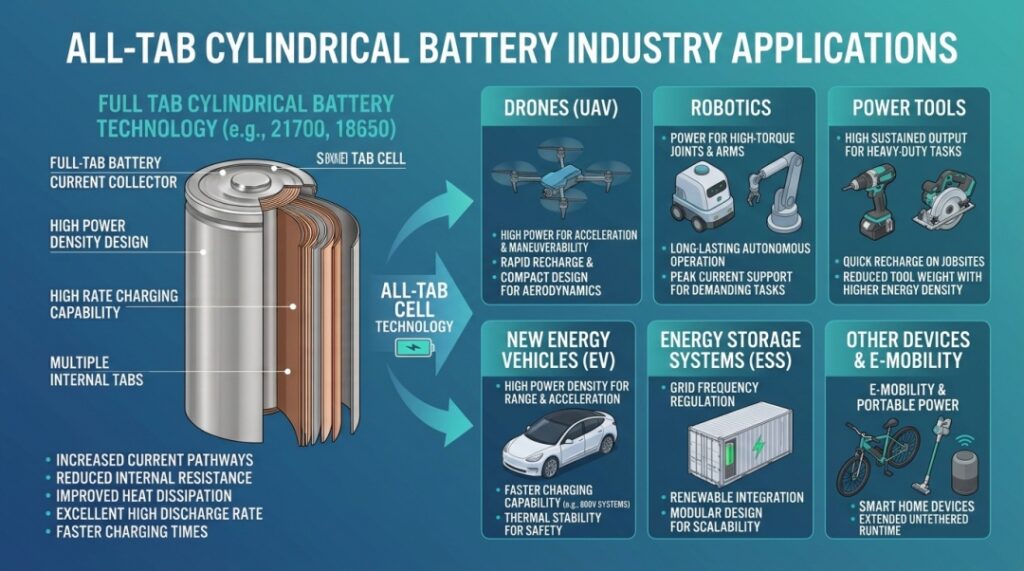
Why lower internal resistance, higher discharge power, faster charging, and better thermal management are reshaping the future of 18650 and 21700 batteries.
What if one of the most important breakthroughs in cylindrical lithium-ion batteries has little to do with developing a new cathode or anode material?
What if the real innovation is simply changing how electricity travels inside the cell?
For decades, cylindrical battery development has focused heavily on capacity, energy density, electrode chemistry, and cycle life.
But another component is now receiving much more attention:
The current collector and tab architecture.
From conventional single-tab designs to multi-tab structures and today’s full-tab, or tabless, cylindrical batteries, the evolution is fundamentally changing the way current flows through the cell.
Some manufacturers report internal-resistance reductions exceeding 70%, continuous discharge currents of 60–100 A or more in selected products, and charging from low state of charge to 80% in approximately 10–15 minutes.
These figures are impressive, although they are product-specific rather than universal characteristics of full-tab cells.
The more important story is the engineering principle behind them.
Full-tab technology is not simply about adding more tabs. It is about redesigning the current path inside a cylindrical battery.
And that change has implications for power tools, industrial drones, eVTOL aircraft, robotics, data-center backup systems, and other high-power applications.
1. The Evolution: From Single-Tab to Multi-Tab to Full-Tab
To understand why full-tab technology matters, we first need to understand how current moves inside a conventional cylindrical lithium-ion cell.
A typical cylindrical battery contains long positive and negative electrode sheets wound into a jelly-roll structure.
Each electrode includes a metallic current collector:
- Aluminum foil on the positive electrode.
- Copper foil on the negative electrode.
These collectors transport electrons between the electrochemically active material and the external terminals.
Traditional Single-Tab Design
In a conventional design, each electrode connects to the external current path through a limited number of welded tabs.
Electrons generated across the electrode must travel laterally through the current collector before reaching those connection points.
This creates several disadvantages:
- Longer current-collection paths
- Higher electronic resistance
- Concentrated current density near the tabs
- Uneven heat generation
- Greater challenges as cell dimensions and power requirements increase
The longer the electrode and the fewer the collection points, the more significant these limitations can become.
Multi-Tab Design
Multi-tab batteries improve the situation by distributing several connection points along the electrode.
Instead of forcing current to travel toward one location, the architecture provides multiple shorter collection paths.
The result can be:
- Reduced current-collector resistance
- Better current distribution
- Lower localized heating
- Improved high-rate discharge capability
For mainstream power tools and moderate-power applications, multi-tab technology remains a practical and cost-effective solution.
Full-Tab or Tabless Design
Full-tab architecture takes the concept further.
Rather than using a few discrete tabs, specially designed exposed portions of the current collectors are brought together at the ends of the jelly roll and connected to current-collection plates.
This creates distributed electrical contact across much more of the electrode width.
Current no longer needs to travel the same long lateral distance toward a small number of tabs.
The result is a shorter, more distributed current-collection path.
That is the fundamental difference.
2. Why Full-Tab Technology Can Dramatically Reduce Resistance
The engineering principle begins with a familiar equation:
R = ρL / A
Where:
- R = electrical resistance
- ρ = material resistivity
- L = effective conduction length
- A = effective conductive cross-sectional area
There are two basic ways to reduce resistance:
Shorten the current path.
Or:
Increase the effective conductive area.
Full-tab architecture can do both.
Shorter Current Paths
In a conventional cylindrical cell, current may need to travel a substantial distance along thin metal foil before reaching a discrete tab.
In a full-tab design, current can be collected through a much more distributed edge-contact structure.
The effective path length is reduced.
Importantly, the maximum current path in a conventional cell is not simply equal to the entire unrolled electrode length. Actual resistance depends on current distribution, electrode geometry, tab placement, and collector thickness.
Nevertheless, the physical advantage of distributed collection is clear.
Larger Effective Contact Area
A conventional tab creates a relatively concentrated electrical connection.
Full-tab architecture distributes that connection across a much larger portion of the electrode edge.
This can reduce current crowding and contact resistance when the joints are manufactured correctly.
More Uniform Current Distribution
When current is concentrated near limited connection points, localized current density can become relatively high.
Full-tab designs can distribute the electrical load more evenly.
That can reduce electrical losses and improve thermal uniformity.
However, one distinction matters:
Reducing current-collector resistance is not the same as reducing total cell internal resistance by the same percentage.
A battery’s total internal resistance also includes contributions from electrodes, electrolyte, interfaces, and other components.
The actual improvement depends on the complete cell design.
3. The Mathematics Behind Lower Heat Generation
The relationship between electrical resistance and heat is straightforward:
P_loss = I²R
Where:
- P_loss = resistive power loss
- I = current
- R = resistance
This equation explains why small resistance improvements become extremely valuable at high current.
Consider a simplified example.
Suppose two cells have effective DC resistance values of:
Cell A: 10 mΩ
Cell B: 3 mΩ
At 40 A discharge:
Cell A:
P_loss = 40² × 0.010 = 16 W
Cell B:
P_loss = 40² × 0.003 = 4.8 W
That represents an approximately 70% reduction in resistive heat generation at the same current.
Now increase discharge current to 80 A.
Cell A:
P_loss = 80² × 0.010 = 64 W
Cell B:
P_loss = 80² × 0.003 = 19.2 W
The difference becomes:
44.8 W per cell.
These are illustrative calculations using assumed effective resistance values, not measurements of particular commercial products. Actual cell heating also involves electrochemical and entropic effects.
But the engineering lesson is powerful:
At high discharge currents, resistance is not a minor specification. It can become a major thermal and performance limitation.
4. Why Lower Resistance Improves High-Power Discharge
A high-power battery must deliver current without excessive voltage drop.
A simplified terminal-voltage model is:
V_load ≈ V_OCV − IR
Where:
- V_load = voltage under load
- V_OCV = open-circuit voltage
- I = discharge current
- R = effective internal resistance
Assume an illustrative open-circuit voltage of 4.0 V and a discharge current of 60 A.
With 10 mΩ resistance:
V_load ≈ 4.0 − 60 × 0.010
V_load ≈ 3.40 V
With 3 mΩ resistance:
V_load ≈ 4.0 − 60 × 0.003
V_load ≈ 3.82 V
That difference is significant.
Lower voltage sag can help maintain:
- Motor speed
- Available torque
- ESC operating margin
- Power delivery
- Usable energy under heavy load
This is particularly important in applications involving sudden or sustained high-power demand.
However, discharge-current ratings must always be interpreted together with their specified temperature limits, cutoff voltages, cooling conditions, and duration.
5. Full-Tab Technology and Fast Charging
High discharge power is only one part of the story.
The same reduction in electrical resistance can also support fast charging.
During charging, electrical losses still increase with current.
Lower resistance can reduce heat generation and help maintain more favorable operating conditions.
But fast charging is more complicated than simply reducing resistance.
Charging performance also depends on:
- Lithium-ion transport
- Anode potential
- Lithium-plating risk
- Electrode thickness
- Electrolyte chemistry
- Temperature
- SOC
- Charging control
For this reason, full-tab architecture should be viewed as an important enabler of fast charging, not a complete solution by itself.
Some commercial full-tab products advertise charging to approximately 80% SOC in around 9–15 minutes.
These results demonstrate the potential of combining low-resistance architecture with suitable electrochemistry and charging protocols.
But they should not be generalized to every cylindrical battery.
A full-tab cell still needs an appropriate charging strategy, thermal design, and protection system.
6. What Commercial Full-Tab Cylindrical Cells Are Already Demonstrating
The technology is moving beyond laboratory prototypes.
Several battery manufacturers have introduced full-tab cylindrical cells targeting demanding power applications.
Representative publicly reported examples include:
ManufacturerCell modelCapacityReported performanceBAK Battery18650-30D3.0 AhUp to 60 A continuous, 120 A pulse; 10–80% charge in 9 minutesBAK Battery21700-50D5.0 AhHigh-power discharge and fast-charging positioningEVE Energy18650 30PL3.0 AhUp to 60 A maximum discharge under specified conditionsEVE Energy21700 50PL5.0 AhUp to 70 A maximum discharge under specified conditionsAmpaceJumbo-Power JP40Product-specificHigh-rate discharge and pulse-power positioningHighstar21700-40PS4.0 AhReported 60 A-class discharge capabilityGreat Power21700-5000Q5.0 AhReported high-rate discharge capability
These figures are not directly comparable without standardized test conditions. In particular, ACIR and DCIR are different measurements, and a manufacturer’s maximum discharge rating may include thermal or time limits.
For example, BAK Battery has publicly described its 18650-30D as a 3.0 Ah tabless cell with internal resistance below 5 mΩ, a 60 A continuous discharge capability, and a 120 A pulse rating for 10 seconds.
EVE Energy also publishes specifications for its 18650 30PL and 21700 50PL, demonstrating the commercial availability of high-power cylindrical cell options.
The important market signal is not that every manufacturer has achieved identical performance.
It is that low-resistance, high-power cylindrical cell design is becoming a major area of product differentiation.
7. Manufacturing Challenges: Flattening and Laser Welding
The electrical advantages are compelling.
But manufacturing full-tab cells is not necessarily easier.
In fact, two processes create significant engineering challenges:
Tab flattening and current-collector welding.
Tab Flattening
After the electrode sheets are wound, exposed current-collector edges must be formed into a suitable connection surface.
This process is often referred to as tab flattening or folding.
The objective is to create a sufficiently uniform structure for reliable electrical joining.
But excessive deformation can cause:
- Metallic debris
- Damaged current collectors
- Uneven contact
- Blocked electrolyte pathways
- Poor electrolyte wetting
- Increased resistance variation
Too little deformation may leave an uneven surface that is difficult to weld consistently.
The manufacturing process therefore requires precise control of geometry, pressure, positioning, and deformation.
Laser Welding
After the collector edges are prepared, they must be electrically connected to the collection plate or terminal structure.
Laser welding is commonly used.
The challenge is achieving reliable joints without damaging the electrode assembly.
Potential problems include:
- Incomplete welds
- Excessive heat input
- Spatter
- Localized damage
- High contact resistance
- Inconsistent joint strength
This creates a strong relationship between the two processes.
Poor flattening quality can directly reduce welding consistency.
For high-volume production, the critical question is not whether a single cell can achieve low resistance.
It is whether millions of cells can achieve consistent electrical and mechanical performance.
8. Why Manufacturing Yield May Decide the Winners
A full-tab design may reduce certain material and processing requirements.
But it can also introduce more demanding production tolerances.
Manufacturers must control:
- Current-collector edge geometry
- Flattening consistency
- Welding penetration
- Contact resistance
- Metallic particle contamination
- Electrolyte wetting
- Cell-to-cell variation
This creates a distinction between theoretical cost and actual manufacturing cost.
Simpler electrical architecture does not automatically mean cheaper production.
If manufacturing yield is low, the cost advantage can disappear.
That is why laser-processing equipment, automated inspection, process monitoring, and quality control are strategically important to full-tab commercialization.
The next stage of competition may depend as much on manufacturing engineering as on cell design.
9. Why Full-Tab Batteries Matter for Industrial Drones
From a UAV battery engineering perspective, full-tab technology is particularly interesting.
Industrial drones frequently experience rapidly changing power demand.
A typical mission may include:
Takeoff → Climb → Hover → Cruise → Payload Operation → Return → Landing
Each phase creates a different electrical load.
During takeoff and climb, the battery may need to deliver substantial current.
During hovering, it must maintain continuous power output.
During sudden maneuvers or wind disturbances, short-duration power demand may increase sharply.
This means UAV batteries must satisfy two different requirements:
Energy capability: How long can the aircraft operate?
Power capability: Can the battery support the most demanding part of the mission?
A battery with excellent Wh/kg but excessive voltage sag may struggle during high-power operation.
Full-tab architecture can help address the power side by reducing internal resistance and improving current collection.
Example: A High-Power UAV Battery Pack
Consider a hypothetical 12S4P battery using 5 Ah cylindrical cells.
Nominal pack capacity:
4 × 5 Ah = 20 Ah
Assume nominal cell voltage is 3.6 V.
Nominal pack voltage:
12 × 3.6 V = 43.2 V
Nominal energy:
43.2 V × 20 Ah = 864 Wh
Now suppose the aircraft requires 200 A during a short high-power phase.
Each parallel cell would carry approximately:
200 A / 4 = 50 A
At this current level, cell resistance and thermal performance become critical.
A low-resistance high-power cylindrical cell may be a candidate, provided the manufacturer’s discharge-duration, temperature, and safety limits support the duty cycle.
However, the pack must also account for:
- Interconnect resistance
- Busbar design
- Cell temperature differences
- Mechanical vibration
- BMS requirements
- Cooling
- Voltage sag
- Aging
A high-power cell does not automatically create a high-power battery pack.
The complete electrical and thermal architecture must be engineered together.
10. Full-Tab Batteries and eVTOL
Electric vertical takeoff and landing aircraft create an especially demanding battery profile.
During vertical takeoff, the propulsion system may require high power.
During cruise, the aircraft may operate at a different power level.
During landing, another high-power phase may occur.
Therefore, eVTOL batteries need to balance:
Specific Energy — Wh/kg
with:
Specific Power — W/kg
High energy density supports range and payload.
High power capability supports takeoff, climb, transition, and emergency operating margins.
Full-tab cylindrical technology may help improve power delivery and thermal behavior.
But aviation battery selection also requires consideration of:
- Cell energy density
- Pack-level mass
- Cycle life
- Thermal propagation
- Redundancy
- Reliability
- Qualification requirements
Full-tab architecture is a promising component technology.
It is not, by itself, an aviation-ready battery solution.
11. Robotics: A Natural Market for High-Power Cylindrical Cells
Robots create a different but equally interesting power profile.
Humanoid robots and quadruped robots frequently perform:
- Rapid acceleration
- Repeated stopping
- Lifting
- Joint repositioning
- Dynamic balancing
- Sudden torque changes
These activities create transient current demand.
High-resistance cells may experience greater voltage sag and heat generation under repeated pulses.
Low-resistance cylindrical cells can help support high peak power.
However, robot battery design also depends on:
- Pack volume
- Weight distribution
- Runtime
- Safety
- Charging
- Communication
- Thermal management
The best robot battery is not necessarily the one with the highest peak-current rating.
It is the one that balances power capability with the robot’s actual duty cycle.
12. Data-Center BBU: Why Power Reliability Matters
Data-center battery backup units, or BBUs, represent another potential growth area.
Unlike batteries optimized primarily for long-duration energy storage, some BBU applications require rapid and reliable power delivery during short interruptions or transitions.
Important requirements may include:
- High pulse-power capability
- Low internal resistance
- Consistent cell performance
- Predictable aging
- Thermal reliability
- Long-term standby behavior
Full-tab cylindrical cells may be attractive for selected high-power backup architectures.
But the technology must also satisfy application-specific requirements for safety, calendar life, monitoring, and system reliability.
In data centers, power performance matters.
Predictability matters just as much.
13. Power Tools: Where Full-Tab Technology Is Already Highly Relevant
Power tools remain one of the clearest application areas.
A cordless drill may experience relatively short power pulses.
An angle grinder or chainsaw can demand sustained high current.
Heavy-duty tools may operate close to the battery pack’s thermal and electrical limits.
Low-resistance cells can help reduce voltage sag and heat generation.
That can improve the ability to maintain power during demanding operation.
But this does not mean every cordless tool requires full-tab batteries.
For light-duty DIY tools, conventional or multi-tab cells may already provide sufficient performance at lower cost.
For high-end professional tools, full-tab technology can offer meaningful advantages.
This suggests a layered market rather than immediate replacement.
Multi-tab cells remain practical for mainstream applications.
Full-tab cells become increasingly attractive where high power, heat, and charging speed create real operating constraints.
14. Is Full-Tab Technology Always Better?
Not necessarily.
A battery is an engineering compromise.
Full-tab technology can improve current collection, but it does not eliminate trade-offs involving:
- Energy density
- Electrode chemistry
- Manufacturing complexity
- Cost
- Cycle life
- Fast-charge degradation
- Safety
- Pack integration
For example, a very high-power cylindrical cell may use an electrode design optimized for rate capability rather than maximum energy density.
That may be ideal for a professional power tool.
But a long-endurance mapping UAV may benefit more from a higher-energy cell with lower peak-current capability.
So the question should not be:
“Is full-tab better than multi-tab?”
It should be:
“Does the application need the electrical and thermal advantages of full-tab architecture enough to justify its trade-offs?”
That is a more useful engineering question.
15. What Should Battery Engineers Compare?
When evaluating a full-tab cylindrical cell, I would focus on the following parameters.
Electrical Performance
- AC internal resistance
- DC internal resistance
- Continuous discharge current
- Pulse discharge current and duration
- Voltage sag under load
- Discharge efficiency at different SOC levels
Thermal Performance
- Temperature rise at different currents
- Cell surface temperature
- Temperature distribution
- Cooling conditions
- Thermal behavior after aging
Charging Performance
- Maximum charging current
- Charging time to 80% SOC
- Charging temperature limits
- Lithium-plating risk
- Fast-charge cycle life
Manufacturing Quality
- Cell-to-cell resistance consistency
- Weld quality
- Mechanical integrity
- Capacity distribution
- Production traceability
Application Compatibility
- Energy density
- Pack dimensions
- Weight
- Vibration resistance
- BMS integration
- Lifecycle cost
A single low-resistance number cannot replace this evaluation.
16. The Competitive Landscape: Chemistry, Architecture, and Manufacturing
The cylindrical battery market is entering a more differentiated stage.
Competition is no longer limited to:
Who can deliver the most Ah?
Manufacturers increasingly compete on:
- Energy density
- Power density
- Internal resistance
- Charging speed
- Thermal performance
- Manufacturing yield
- Cost consistency
Companies such as BAK Battery, EVE Energy, Ampace, Great Power, Highstar, and other cylindrical-cell manufacturers have been developing or promoting high-power and full-tab-related products.
Equipment suppliers are also important because the full-tab manufacturing process requires advanced joining and inspection capabilities.
The companies that succeed will need more than attractive laboratory performance.
They will need repeatable manufacturing quality and products that solve specific customer problems.
17. What Happens Next?
I expect the market to continue evolving in layers.
Mainstream Applications
Conventional and multi-tab cylindrical batteries will remain relevant where cost, established supply chains, and sufficient performance matter most.
High-End Professional Applications
Full-tab batteries may gain share where high discharge current, reduced voltage sag, and faster charging create measurable value.
Emerging Applications
Robotics, high-power BBUs, industrial UAVs, and certain eVTOL architectures may create additional opportunities for low-resistance cylindrical cells.
However, market penetration will depend on more than cell performance.
Manufacturing cost, qualification, safety, and pack-level integration will determine how quickly each application adopts the technology.
18. The Bigger Trend: Battery Performance Is Becoming an Architecture Problem
The evolution from single-tab to full-tab illustrates a broader trend in battery engineering.
Improving batteries is not only about discovering new materials.
Sometimes the greatest gains come from redesigning the physical architecture around existing electrochemistry.
In this case:
Shorter Current Paths
↓
Lower Electronic Resistance
↓
Reduced Voltage Sag
↓
Lower Resistive Heat Generation
↓
Greater High-Power Capability
↓
More Application Possibilities
But each improvement must be validated at cell level and then again at pack and system level.
The architecture creates the opportunity.
Manufacturing and system engineering determine whether that opportunity becomes practical performance.
Final Thoughts: Full-Tab Is a Redesign of the Current Path, Not Just the Tab
The evolution from single-tab to multi-tab and full-tab cylindrical batteries is more significant than it first appears.
It changes how electrons travel through the current collectors.
It changes how electrical resistance is distributed.
It changes where heat is generated.
And it changes the power-performance possibilities of cylindrical lithium-ion cells.
The most important engineering insight is simple:
Lower internal resistance is the result. A shorter, more distributed current path is the underlying reason.
For power tools, that can mean stronger performance under demanding loads.
For robotics, it can support repeated high-power movements.
For data-center BBUs, it can improve the options available for high-power backup design.
For industrial UAVs and eVTOL, it may help engineers balance power delivery, voltage stability, and thermal performance.
But full-tab is not a universal replacement for every cylindrical battery architecture.
Its greatest value appears when the application genuinely benefits from high current, reduced electrical losses, and improved thermal distribution.
The next stage of competition will be determined not only by who achieves the lowest resistance, but by who can manufacture reliable cells consistently and integrate them into useful energy systems.
The future of cylindrical batteries is not simply about storing more energy.
It is also about delivering that energy more efficiently, more reliably, and exactly when the application needs it.
And that is why full-tab technology deserves serious attention.
Discussion: Which application do you believe will benefit most from full-tab cylindrical batteries over the next five years—professional power tools, robotics, data-center BBUs, industrial UAVs, or eVTOL?
#FullTabBattery #TablessBattery #CylindricalBattery #LithiumIonBattery #BatteryEngineering #BatteryTechnology #HighPowerBattery #18650Battery #21700Battery #DroneBattery #UAVEngineering #Robotics #EnergyStorage #BatteryInnovation